“You decide for yourself when it will hurt”
Out Stealing Horses“You decide for yourself when it will hurt” is a rule Trond’s father teaches through action as much as speech. First, he pulls up a patch of stinging nettles with his bare hands after Trond avoids cutting them; later, Trond recalls that lesson while struggling with heavy work at Odd’s funeral. Across the two scenes, the rule does not make pain unreal. It gives Trond a way to choose his response to it, and turns physical endurance into a lesson in attention, self-command, and his father’s approval.
The lesson in the nettles
A week before the funeral, Trond’s father asks him to cut the overgrown grass behind the cabin. Trond uses a short scythe, a tool new to him, and works with all his strength until he has done well enough to feel sweaty and satisfied. But beside the cabin wall grows a dense patch of tall stinging nettles. Trond arcs around it rather than cutting it down. The work he has completed and the task he has avoided sit side by side: effort alone is not the whole test; he must decide whether discomfort will stop him.
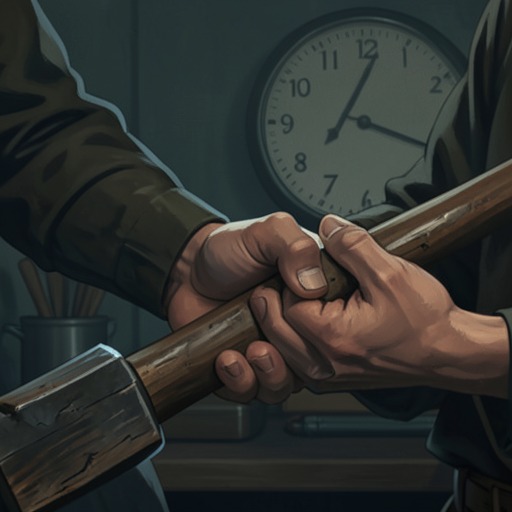
Trond’s father notices the uncut plants and asks why he has left them. Trond answers that they will hurt. His father responds, “You decide for yourself when it will hurt.” He then walks over, takes hold of the nettles with his bare hands, and pulls them up one after another, calmly continuing until the whole patch is gone. Nothing in his face indicates pain. The instruction is therefore demonstrated in a concrete act: Trond’s father does not deny that the plants sting, but refuses to let anticipated pain determine what he can do.
The lesson lands in Trond’s body rather than as an abstract maxim. Ashamed, he follows Jon along the forest path, straightens his posture, changes his gait, and walks normally again after only a few steps. He had been moving as though he could not manage the walk back; now he cannot understand why he did not alter his gait sooner. The scene gives the rule a limited, practical meaning: Trond can reconsider how he carries himself, even while pain and physical strain remain part of his experience.
A lesson recalled under strain
At Odd’s funeral, the remembered instruction returns during work in the field. Barkald divides the meadow into four sections and begins mowing with a horse-drawn machine. Trond’s task is to carry a heavy reel of wire, hold it taut, and walk backwards across the freshly cut grass. The reel’s worn handles shine from use. As he unrolls it, his wrists begin to ache and his shoulders hurt from managing several demands at once. The wire eventually becomes easier to draw out, but Trond is already exhausted.
The work also exposes his insecurity about being a city boy among people accustomed to physical labor. Jon’s mother is watching him with a gaze he experiences as blinding, and he does not want anyone there to see how much the task costs him. In this setting, the earlier maxim returns in a modified form: Trond decides when the pain should register and whether it should show. He pushes it down into his body, keeps his arms raised, and carries the reel to the end of the meadow. There he sets it down with the wire taut, straightens calmly, puts his hands in his pockets, and lets his shoulders sink. The composure is deliberate, but it does not erase the cost: he feels as if knives are cutting his neck and walks slowly back to the others.
Approval and the rule’s limits
As Trond passes, his father casually raises a hand, strokes his back, and quietly tells him, “You did good.” The brief recognition changes the moment for Trond: the pain vanishes, and he is eager for the next task. This consequence makes the lesson more than a test of solitary toughness. His father’s touch and approval matter; Trond’s self-command takes place under his father’s gaze, and the acknowledgment gives his effort a meaning that the physical burden alone did not provide.
The two episodes establish both the force and the limits of the rule. With the nettles, Trond’s father models calm action rather than merely instructing his son to be brave. In the field, Trond applies the lesson to demanding work, choosing to conceal his strain from the people around him and to continue until the task is finished. Yet the scene records aching wrists, shoulders, and neck, not effortless mastery. The maxim is not presented as proof that pain can simply be switched off: Trond’s pain is first suppressed and then, after his father’s praise, experienced as gone. Its emphasis falls instead on agency—on the space between anticipating pain, showing it, and deciding how to proceed.
Recurrence and significance
The phrase links an intimate exchange beside the cabin to a public, collective task at a funeral. Its recurrence gives the earlier memory a practical afterlife: Trond carries his father’s example into a new circumstance and makes it his own. The first scene concerns an avoided task and the anticipation of a sting; the second concerns sustained labor, exhaustion, and the wish not to appear incapable. In each, a choice about pain becomes visible through posture and action.
The rule also clarifies the bond between Trond and his father without turning it into a lesson delivered only in words. His father removes the nettles himself, watches Trond’s work, and offers a restrained gesture of praise when the wire is laid. Trond responds first by changing his gait and later by pushing through the work, then receives his father’s recognition as sufficient. The maxim’s lasting significance lies in that pattern of example, effort, and acknowledgment: it offers Trond a way to act within physical discomfort while tying that effort to the particular relationship in which he learned the rule.